
Silage wrap UV ageing: a UK outdoor-storage specification
A UK buyer’s guide to silage wrap UV ageing: compare weathering reports, retained properties and storage evidence without converting test hours into service months.
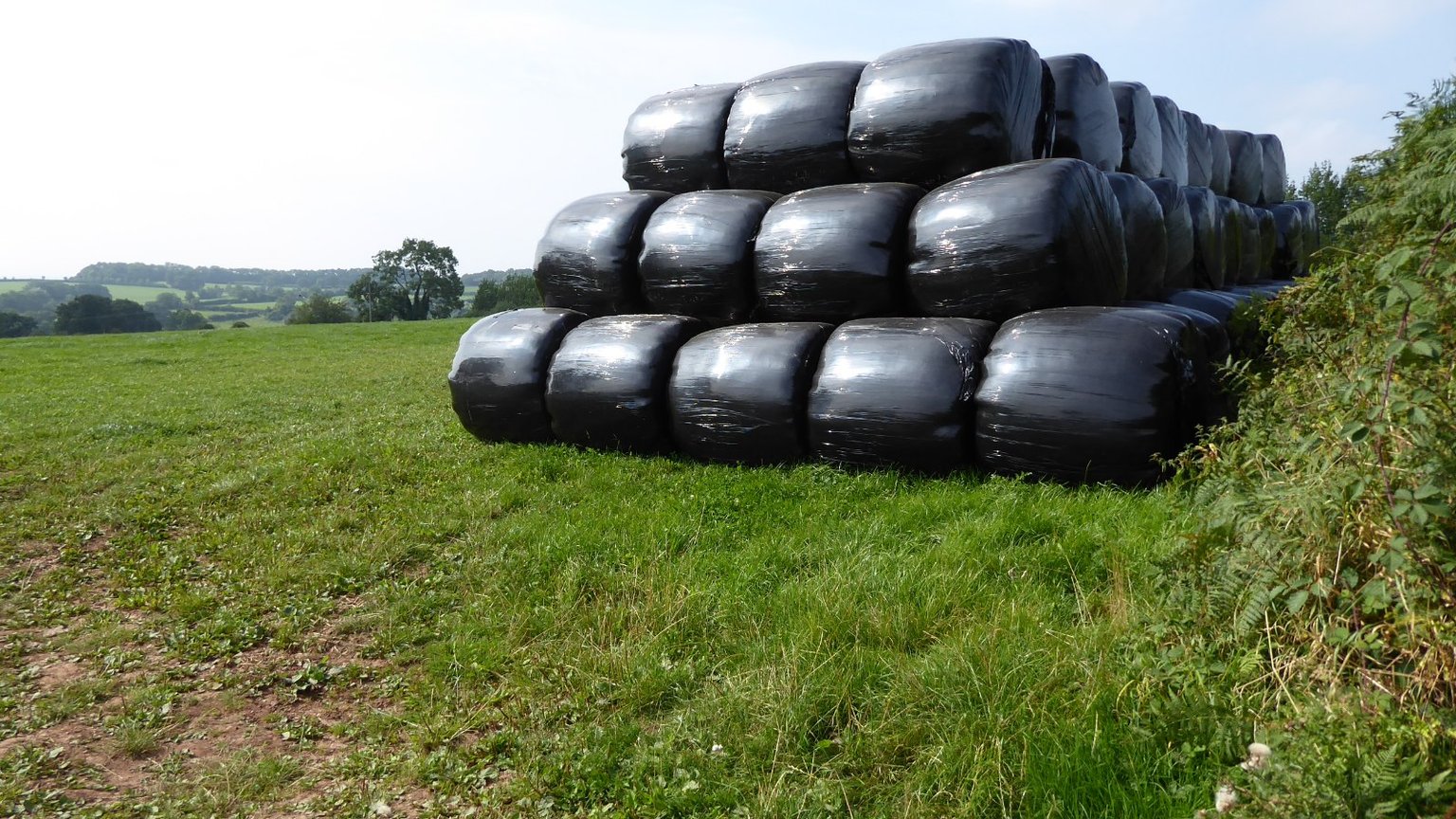
Photo: Philip Halling
Silage bales, photographed at Little Cowarne, Herefordshire, on 5 September 2021. Archive photograph from Geograph Britain and Ireland; this is not a Nexis site or product, and the image does not establish film composition, weathering performance or storage life.
Philip Halling · Wikimedia Commons · CC BY-SA 2.0 · Cropped to 16:9, resized and optimised as JPEG. The adapted photograph is also offered under CC BY-SA 2.0.
A silage-wrap quotation says “UV stabilised”, while the laboratory attachment gives a number of exposure hours. For a UK farm, wrapping contractor or distributor planning outdoor storage, the missing link is what those hours demonstrate about the film being supplied. They do not, by themselves, establish how many months a wrapped bale will remain protected.
This guide addresses PE stretch film for wrapping forage bales. It proposes a purchasing file that connects a weathering report, properties measured after exposure and evidence from the intended storage conditions. It does not set a universal UV lifetime or cover the approval of clamp-cover sheets and greenhouse films as if they were the same product.
The technical context for the 2026 buying season
BS EN 14932:2025 is the UK implementation of the European standard for thermoplastic stretch films used to wrap silage bales. The BSI preview records publication on 31 July 2025 and withdrawal of the 2018 edition. Its contents distinguish durability, resistance to weathering, film acceptance and instructions for use. [1]
On 16 March 2026, BASF highlighted light-stabiliser solutions for agricultural films, discussing sunlight, heat and agricultural chemicals together. That announcement concerns its additive portfolio and includes greenhouse and mulch-film applications; it is not evidence of the outdoor life of a particular silage wrap. [2]
Our purchasing conclusion is to qualify the finished film and its use conditions. An additive name, a colour description or a new resin proposal should lead to a request for relevant evidence, rather than an assumed storage guarantee. If a contract calls for BS EN 14932:2025, ask the laboratory to identify the applicable requirements in the complete document.
Separate the exposure method from the product acceptance decision
ISO 4892-3:2024 describes exposure of plastic specimens to fluorescent UV radiation, heat and water in equipment designed to simulate weathering effects. It is an exposure method, not a statement that every material surviving a chosen duration is suitable for a particular farm. [3]
The BS EN 14932:2025 preview lists a dedicated weathering procedure and a dated xenon-arc reference among its normative references. It also identifies informative material concerning other light sources and artificial-to-natural exposure correlation. [1] Consequently, a report headed only “ISO 4892” or “UV test” does not establish which silage-film requirement has been met. Have the laboratory explain the selected method and any proposed alternative before commissioning the comparison.
Do not combine results from different lamp systems or cycles into one ranking simply because the reported hours match. Keep the exposure report and the resulting product-performance assessment as two linked records. A conformity claim needs the applicable complete assessment, rather than a selected line from an exposure log.
Why laboratory hours are not a universal number of months
Weathering-equipment manufacturer Q-Lab explains that there is no universal multiplier from accelerated exposure hours to outdoor years. Site, season, specimen orientation, material and test conditions influence the relationship. Its correlation bulletin was posted in 2023 and updated in 2025. [4]
This does not make laboratory testing unhelpful. The same bulletin describes the value of comparative durability data and the limits of relationships developed from paired laboratory and outdoor experience: they remain specific to the material, test programme and exposure conditions used. [4]
For the buyer, the useful question is therefore: “How does this identified film compare with our accepted reference under the agreed programme, and what supports the proposed storage claim?” Avoid a conversion assembled from an unrelated product, climate or lamp cycle. Where a supplier relies on a correlation or a standard’s guidance, request its basis and confirm its applicability with the laboratory.
Define the UK storage job before requesting the report
Write down the delivery postcode or region, planned wrapping dates and latest intended opening date. “One season” is ambiguous if one party means the wrapping campaign and another means the period until the next harvest. Keep storage of unused rolls separate from outdoor service after application.
Record bale shape and dimensions, wrapper model, intended stretch and coverage, film colour and nominal gauge. Ask the supplier to state the installation and storage conditions attached to its recommendation. A product-specific storage claim should identify the relevant construction and application; it should not silently extend to every colour or thickness in a range.
For converters considering a PE, pigment, stabiliser or recycled-feedstock change, retain the formulation revision and its location in the film structure. Do not infer unchanged durability from unchanged melt-flow rate or from a previous report on a different construction. Define which changes trigger fresh qualification.
A weathering-report checklist for the purchasing file
The following is an editorial commissioning checklist, not a reproduction of a standard procedure. The responsible laboratory should select specimen preparation, exposure settings, replicates and evaluation methods from the applicable complete specifications.
- Identify the film, batch, roll, formulation revision, colour, measured thickness and sampling locations.
- State the exposure method and edition, lamp system and filter where relevant, operating cycle, irradiance basis, temperatures, moisture stages and exposure duration.
- Describe whether specimens were strained or unstrained, their mounting and orientation, and the preparation required by the selected procedure.
- Identify the unexposed controls and accepted reference film; explain how specimens were assigned to the comparison.
- Report the agreed properties before and after exposure, their methods, test directions, individual results and any limits on interpretation.
- Record cracking, embrittlement or other observed failure modes with photographs and traceable specimen identifiers.
- State the acceptance requirement being assessed and distinguish a laboratory comparison from an outdoor-service-life claim.
An incomplete report is a reason to seek clarification or repeat an appropriate comparison. It is not a reason to invent missing settings or assume that a supplier’s longer exposure was necessarily more severe.
Read retained properties alongside their starting values
For a development comparison, an agreed retention calculation can help organise the data: retained property (%) = 100 × property after exposure ÷ corresponding unexposed property. Define the property, specimen groups and calculation before testing. Use the calculation required by the product specification where a conformity assessment is intended.
For example, record the original and exposed tensile strain-at-break results as well as any retention ratio, keeping machine and transverse directions separate. Two films can show similar percentage retention while starting from different property levels. A ratio should not conceal a weak initial value, a wide spread of results or a change in failure mode. No universal retention threshold is proposed here.
Do not treat colour appearance as a replacement for mechanical evaluation. Likewise, a weathered specimen’s mechanical result does not establish bale airtightness. Keep wrapping performance, damage and the other agreed film requirements in the acceptance file.
Use stored-bale observations to investigate, not to guess a cause
In a planned comparison, keep identifiable groups of reference and candidate wraps under documented, comparable conditions. Record wrapping settings, location, application date, handling events and inspection dates. Follow the film and equipment suppliers’ instructions for use and storage.
If a damaged area appears, record its position and appearance before attributing it to UV ageing. Handling punctures, abrasion, exposure-related changes and installation problems need investigation. Photographs and retained samples allow the supplier and laboratory to assess the failure mode; a single photograph cannot establish the cause or a remaining service life.
Keep forage condition and the physical integrity of the wrapping as separate observations. Arrange any forage-quality assessment with the responsible farm adviser; do not use this film-qualification exercise as a feed-safety decision.
For the broader wrapping and field-trial checklist: https://www.nexisplast.com/en/insights/silage-film-export-field-trial
Make the commercial promise specific
Ask the supplier to put the scope of any outdoor-storage claim in writing: product and revision, application conditions, geographical applicability, period covered, exclusions and the evidence needed for a complaint. Agree batch identification, retained samples and the response to a change of formulation. A laboratory result and a commercial warranty have different roles.
For a UK quotation, state GBP or the agreed currency, roll quantity, dimensions, named delivery point, freight coverage and whether VAT is included or excluded. Compare actual film consumption, stoppages, additional wrapping and rejected units against the same agreed job. Include investigation or replacement costs where they are measured; do not turn an unverified durability claim into an assumed saving.
Send Nexis a durability-focused brief
Provide the wrapper model, bale dimensions, current film details, colour, intended application settings, UK storage location and wrapping-to-opening dates. Attach the available weathering report, before-and-after property data and photographs of any failure. For a raw-material enquiry, include the PE family, current formulation, proposed changes and film process.
State the trial quantity, seasonal demand and delivery postcode. Ask Nexis to review suitable film or material options, available documentation and representative-sample arrangements against that brief. Grade availability, application suitability and any storage commitment must be confirmed for the specific supply. This article is not a Nexis test certificate or a claim about the film in the photograph.
Silage stretch film enquiries: https://www.nexisplast.com/en/products/silage-stretch-film
Polymer raw materials: https://www.nexisplast.com/en/products/polymer-raw-materials
Send the technical brief: https://www.nexisplast.com/en/contact
Primary sources and review date
Published and sources reviewed on 3 November 2026. Standard descriptions use public scope information and the BSI preview, not the full paid procedures. The purchasing checklist, proposed comparison and commercial handover are Nexis editorial recommendations.
[1] BSI, BS EN 14932:2025, Plastics — Thermoplastic stretch films for wrapping silage bales. Public preview supplied through ANSI; UK publication date 31 July 2025, including the contents and normative-reference list: https://webstore.ansi.org/preview-pages/BSI/preview_30491480.pdf
[2] BASF, Chinaplas 2026: BASF showcases innovative additive solutions, 16 March 2026; agricultural light-stabilisation context, not a silage-wrap qualification: https://www.basf.com/global/en/media/news-releases/2026/03/p-26-040
[3] ISO 4892-3:2024, Plastics — Methods of exposure to laboratory light sources — Part 3: Fluorescent UV lamps; fifth edition, October 2024, public scope: https://www.iso.org/standard/83802.html
[4] Q-Lab, LU-0833 Correlation Questions & Answers; page marked Posted 2023 and Last Updated 2025. Limits of accelerated-to-outdoor correlation: https://www.q-lab.com/document-library/lu-0833-correlation-questions-answers