
PE film thickness variation: a UK buyer’s acceptance plan
Qualify PE film downgauging with a roll thickness map, matched measurement methods and converting trials. A practical acceptance plan for UK industrial buyers.
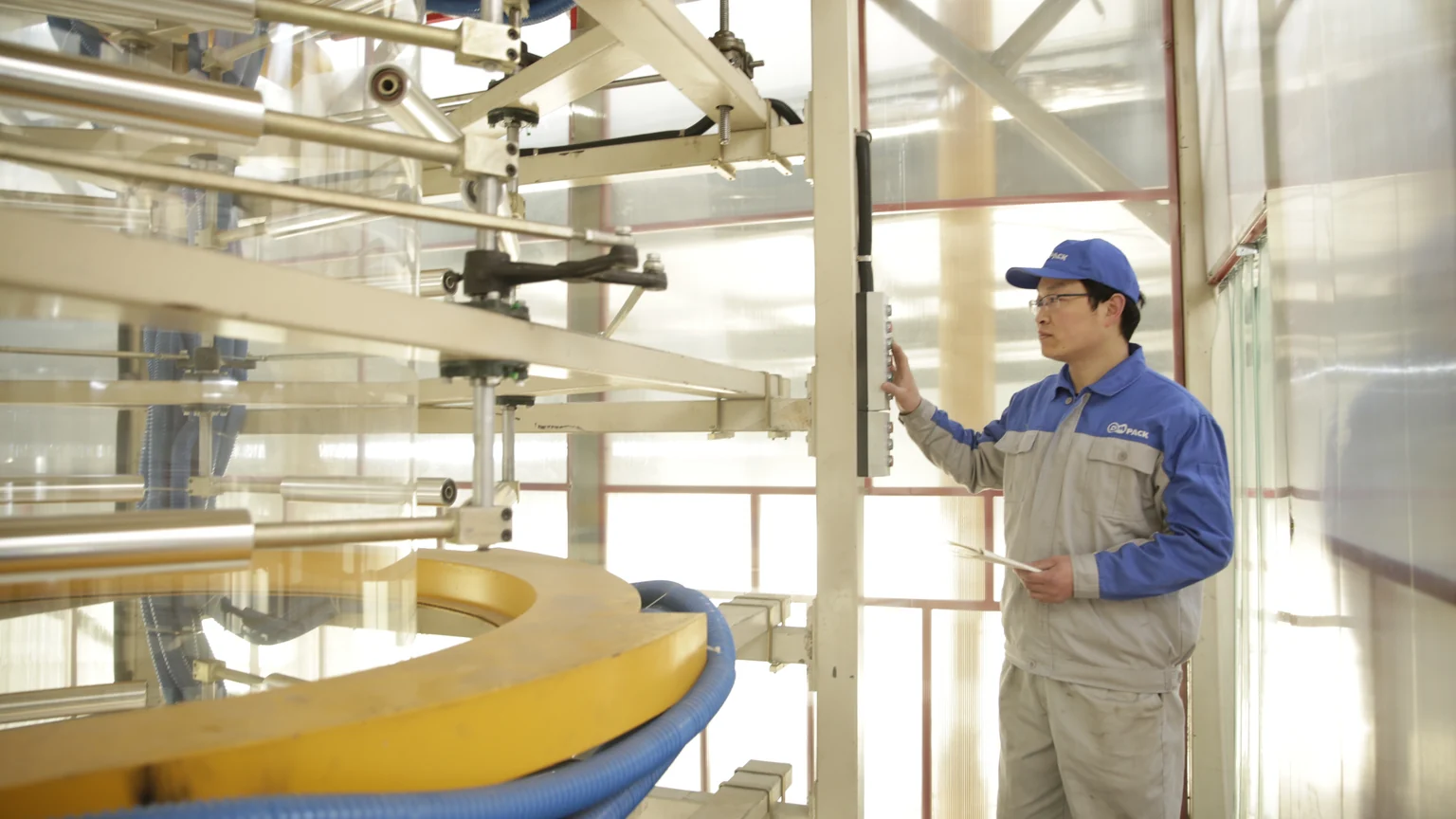
Photo: DMPACK
Real archive photograph of polyolefin shrink-film production, as described by its source. It illustrates film processing, not a thickness test or a Nexis facility. It does not establish the resin formulation, recycled content or measured tolerance of any supplied film. Visible third-party branding does not imply endorsement.
DMPACK · Wikimedia Commons · CC BY-SA 4.0 · Cropped to 16:9, resized and converted to WebP. This image adaptation is also available under CC BY-SA 4.0.
A lower nominal micron figure can make a PE film quotation look efficient. The purchasing question is whether the delivered rolls maintain the agreed thickness distribution and still run, seal and protect the product. An average thickness alone cannot describe where the thinner and thicker regions occur.
For UK industrial packers and converters evaluating PE shrink film or form-fill-seal film, this guide proposes a roll acceptance dossier before approving downgauging. It applies to non-food industrial packaging. It does not prescribe a universal tolerance, promise a saving or certify a Nexis grade. The sampling and purchasing checklist below is an editorial proposal to agree with the converter and laboratory.
The 2026 development: specify what the measurement means
ASTM lists D6988-26 as active, with an update dated 20 August 2026. Its public scope concerns film specimen thickness used in calculating other test results. Crucially, it excludes commercial classification and quality-control thickness sampling. Citing that guide on a quotation therefore does not define how an entire delivery is sampled or accepted. [1]
A separate industrial example shows why a tolerance figure needs context. In a release dated 21 April 2026, Reifenhäuser describes a seven-layer barrier-film installation producing a 70 µm film with profile accuracy better than ±3% at 2σ. Those are the manufacturer's reported conditions for that installation, not a tolerance to copy into an unrelated PE film order. [2]
Our procurement conclusion is to ask what each figure describes: the mean, observed extrema, a statistical spread, or a guarantee under an agreed inspection plan. A statistical profile statement must not silently become an absolute limit at every point on every roll.
Define the film geometry before measuring it
Record the construction as a single web, an unslit tube, a gusseted tube or another specified format. Include usable width, nominal thickness, layers and any surface texture. Mark machine direction and transverse direction on retained samples, and identify the reel edge and the positions that become a bag body, fold or seal.
For a tube, be explicit about whether the reported thickness represents one wall or stacked walls. Dividing a two-wall reading by two only produces an average of those walls; it does not demonstrate their individual thicknesses. Folds and gussets can also create unintended stacks. Have the laboratory define how a single wall is isolated without stretching or damaging it.
Agree where measurements apply. A width-average requirement, a point requirement and a bag-body requirement are different contractual statements. If an edge is trimmed before use, record the usable region rather than mixing trim and finished web data without explanation.
Keep three measurement questions separate
For local mechanical measurements, ISO 4593:1993 addresses thickness by mechanical scanning and excludes embossed film. ISO's catalogue says the edition was confirmed in 2025. Select a suitable method for the actual surface and document the instrument and measurement conditions. [3]
For average thickness and roll yield, ISO 4591:1992 uses gravimetric techniques based on mass, area and density. The catalogue records confirmation in 2022. This answers an average-material question; our recommendation is to retain a separate local profile because the average does not locate thin areas. [4]
For thickness used in another laboratory property calculation, check that test's instructions and the applicable dimensional guide. ASTM D6988-26 also cautions that its procedures and practical portable measurements need not agree exactly; ASTM and ISO 4593 differ in technical content. Do not combine values from unlike methods into one acceptance series without a laboratory assessment. [1]
Ask which density was used if thickness is inferred from mass and area. With a formulation change, including recycled PE, fillers or colour additives, document the density basis instead of silently retaining a value from the previous recipe. Compare mass per area directly where useful, while keeping it distinct from locally measured thickness.
Build a roll map that can be repeated on the next delivery
Before the trial, agree the lot definition, reel selection, sampling locations and number of readings with the responsible quality team. Define how retained samples and any disputed roll will be handled. The following proposed dossier provides a structure, not a standardised sample count:
- Traceability: supplier batch, production date, reel ID, formulation revision and the approved reference reel.
- Position: distance across usable width, lengthwise location, wall or face, and correspondence to the finished pack.
- Measurement: method and edition, calibrated instrument, preparation, conditioning and contact conditions where relevant.
- Raw results: individual readings and their positions, followed by the stated summary statistics and units.
- Decision: the agreed mean requirement, local limits, treatment of uncertainty and the rule for additional investigation or rejection.
Repeated scans across the width and samples from agreed lengthwise locations help distinguish a persistent band from a change along the roll. Keep those locations visible in the record. Do not present the smallest sampled result as proof of the absolute minimum anywhere in the production lot.
Inline profile data can provide useful production context. Ask the supplier how the sensor, scanning pattern, calibration and data averaging relate to the offline measurement. An online trace and a laboratory reading need an agreed comparison, not an assumption that their numbers are interchangeable. Preserve material-change and start-up records separately from the defined commercial production window.
Change the material and the gauge in controlled stages
A different LDPE/LLDPE blend or recycled PE source should have a traceable material identity and trial record. In our proposed sequence, first establish the current reference film and its measurement profile. Then evaluate the candidate formulation at the agreed reference construction before testing a separate reduction in nominal thickness.
If commercial constraints require several changes together, label the trial as approval of that complete material-and-process combination. Record the recipe revision, layer arrangement, line settings and actual roll profile. Do not attribute a result to the resin alone when extrusion conditions or film geometry changed as well.
Avoid adjusting the nominal target until a few hand-picked samples pass. Pre-agree the inspection plan, retain the unsuccessful results and explain any repeat. Release the candidate only when the complete evidence meets the intended purchase requirement.
Connect the profile to converting and pack performance
Run the candidate rolls through the intended packing equipment at documented settings. For FFS sacks, map the sample locations to bag body, gusset and seal, then retain the relevant filled-sack results. For shrink film, retain the bundle design, sealing conditions, tunnel settings and the subsequent handling assessment.
Record web handling, breakages, rejects, stoppages and acceptable output. Mechanical, sealing and end-use acceptance criteria remain independent: a good thickness map is not a substitute for a successful pack trial. If a defect appears, trace it back to its roll position and investigate the material and process evidence together rather than declaring thickness the cause from a photograph.
The previous Nexis guide addresses the separate puncture question for FFS sacks: https://www.nexisplast.com/en/insights/pe-ffs-sacks-puncture-dart-impact-uk
Compare the cost of accepted output for the UK delivery
Request quotes on the same basis: usable dimensions, net film mass excluding the core, quantity, currency, named delivery point and Incoterm, with freight and applicable charges clearly allocated. State the UK delivery postcode and whether the offer concerns resin or finished film. A resin price per tonne and a film price per reel are different cost inputs.
For the trial, calculate film consumed per accepted pack and combine it with the actual conversion losses and agreed operating costs. Report rejects and downtime alongside material consumption. A lower micron target should earn approval through measured output, not an assumed saving percentage.
Write the commercial change-control rule into the order: which changes to formulation, recycled feedstock, usable width or production conditions require notification and requalification? Keep the first commercial delivery linked to the accepted trial. An acceptance plan is useful only if the next purchase can be checked against it.
Send Nexis a specification that can be assessed
For a PE-material or film enquiry, provide the application, existing formulation or available material documentation, film geometry, nominal thickness and current roll map. Add the packing machine, output target, failure history, recycled-content requirement, trial quantity, monthly demand and UK delivery postcode. Include the proposed measurement and acceptance rules.
Ask Nexis to review available material or film options and supporting documents against this brief. Grade availability, suitability and sample provision must be confirmed for the individual enquiry; this article does not imply that Nexis owns the illustrated equipment or has issued a test report for your application.
Polymer raw materials: https://www.nexisplast.com/en/products/polymer-raw-materials
FFS film: https://www.nexisplast.com/en/products/ffs-bag
Shrink film: https://www.nexisplast.com/en/products/shrink-film
Technical enquiry: https://www.nexisplast.com/en/contact
Sources and review date
Published and sources checked on 29 October 2026. Standard references use public catalogue scopes, not the complete procedures. Sampling, staged trials and commercial decision rules are Nexis editorial recommendations, to be agreed for the application.
[1] ASTM D6988-26, Standard Guide for Determination of Thickness of Plastic Film Test Specimens; active catalogue entry updated 20 August 2026: https://store.astm.org/d6988-26.html
[2] Reifenhäuser, Smurfit Westrock open-house report, published 21 April 2026, describing the 15 April demonstration and its specific profile-performance claim: https://reifenhauser.com/en/company/media/news-and-stories/press-releases/smurfit-westrock-shows-new-reifenhaeuser-ultra-die-heads
[3] ISO 4593:1993, Plastics — Film and sheeting — Determination of thickness by mechanical scanning; confirmed in 2025: https://www.iso.org/standard/20759.html
[4] ISO 4591:1992, gravimetric average thickness and roll yield; confirmed in 2022: https://www.iso.org/standard/10527.html