
PE FFS sacks: qualify puncture resistance beyond dart impact
A UK buyer’s guide to PE FFS sacks: distinguish dart impact from slow puncture, compare recycled film fairly and approve the filled bag before ordering.
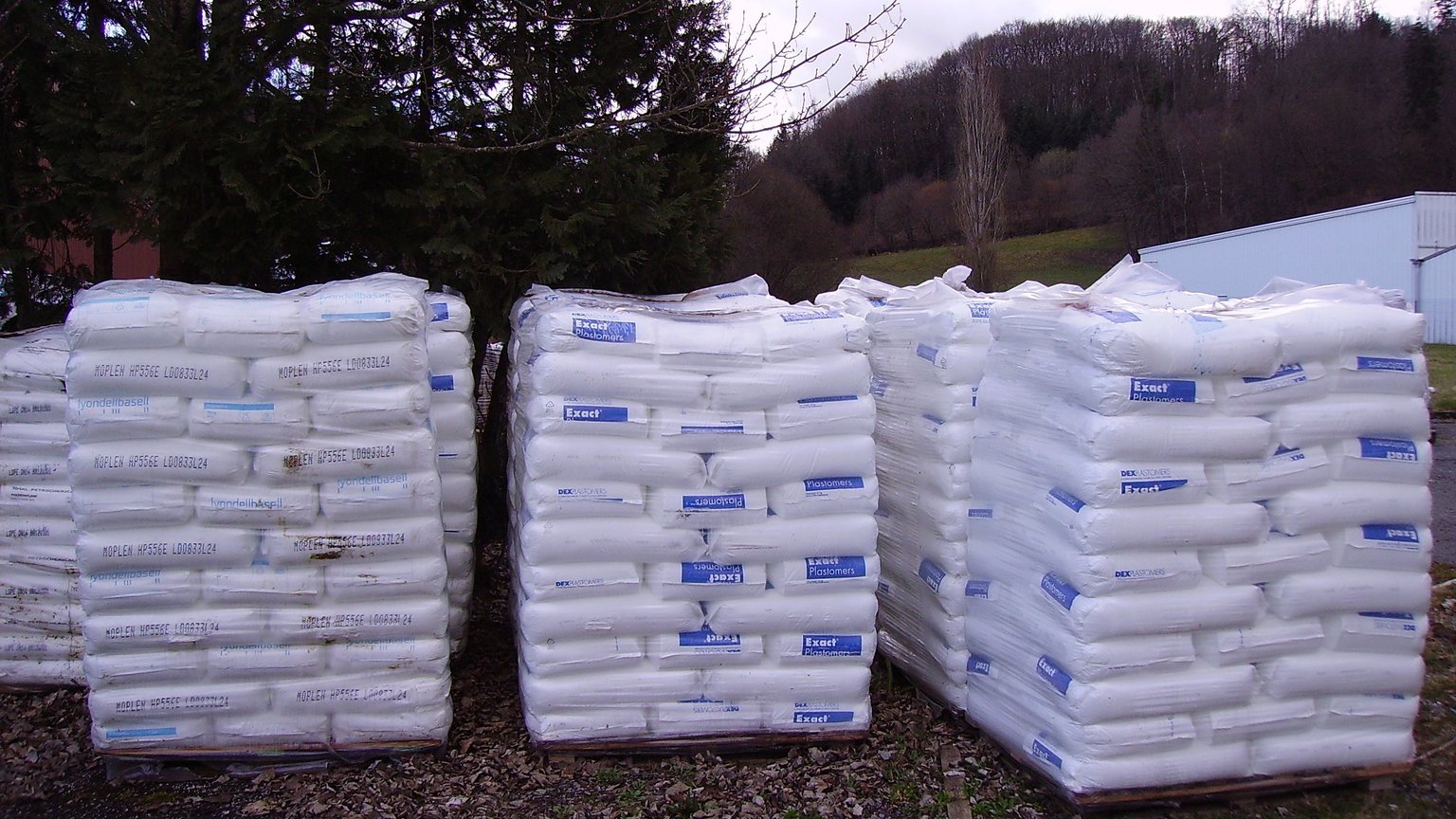
Photo: Cjp24
Real archive photograph of polymer resin sacks, taken on 18 March 2012. This is not a Nexis site or a recommended storage arrangement. The image does not establish sack construction, recycled content or test performance; third-party trade marks do not imply endorsement or a supply relationship.
Cjp24 · Wikimedia Commons · CC BY-SA 3.0 · Cropped to 16:9, resized and optimised as JPEG. This image adaptation is also available under CC BY-SA 3.0.
A PE film can have an impressive dart-impact result and still need a separate investigation when a filled sack develops a small hole during handling. For a UK compounder, resin distributor or industrial packer buying form-fill-seal (FFS) film, the purchasing question is specific: what evidence shows that the proposed film will protect this product, in this sack format, on this route?
This guide concerns non-food industrial sacks. It sets out a proposed acceptance plan for changing PE grades, introducing recycled PE or reducing film thickness. It does not assign a universal pass value, prescribe a recycled percentage or claim that a particular Nexis film has passed these tests.
Why this deserves a separate approval in 2026
ExxonMobil’s Interpack 2026 portfolio includes a PE-based FFS heavy-duty sack developed with Scientex, W&H and Haver & Boecker for moisture-sensitive fine powders. The manufacturer presents packaging redesign and material reduction as application-specific opportunities. That is a useful current example of why sack development needs both a material decision and a packaging-system trial. It is not evidence that every PE film or recycled feedstock will behave similarly. [1]
A separate ExxonMobil–Reifenhäuser case study evaluates a tracked, multi-cycle recycled PE sack structure using several properties, including dart impact and puncture force. The distinction matters: the manufacturer did not present those properties as one interchangeable measurement. Its particular recycled-content result should not become a generic specification for an unrelated supply. [2]
Start with the damage, not a stronger-resin request
Before requesting a new formulation, keep a damaged sack and record where the failure started. Was there a small hole in the body, damage near a gusset, a tear beside a seal, or an opened seal with intact surrounding film? Photograph the defect with its position on the filled sack, and link it to the roll, filling shift and pallet location.
Treat the possible cause as a hypothesis. Inspect the actual product, transfer points, pallet condition and contact surfaces with the responsible site team. A hole alone does not prove poor resin, and a high laboratory result does not eliminate equipment or handling damage. Keep leakage through a designed vent separate from an unintended perforation.
For repeat orders, turn this record into a short failure description: product and fill mass, location and frequency of damage, time after filling, and the handling sequence before discovery. That gives purchasing and the converter the same problem to solve.
Dart impact is a film comparison under defined conditions
ASTM D1709-24 concerns a falling-dart impact and estimates the dart mass associated with failure of half the specimens. Method A and Method B use different conditions; their results are not directly interchangeable. Film quality and manufacturing history also affect the measurement. [3]
Ask the laboratory to identify the edition, method, conditioning, specimen thickness and reported units. Do not turn a result expressed as dart mass into a puncture force or a guaranteed filled-bag drop height. Nor should an impact figure simply be divided by film thickness to declare two different gauges equivalent. [3]
Use the method as one agreed comparison between the approved reference film and the candidate. An attractive supplier data-sheet value is not automatically a result for the commercial roll being delivered.
Slow puncture answers a different question
ASTM F1306-21(2025) characterises flexible films and laminates using a driven probe at a controlled slow rate, reporting force, energy and penetration at failure. Response depends on the probe, temperature, speed and film properties. Have the laboratory confirm whether its scope and arrangement suit the proposed sack-film comparison. [4]
Request the test identification and the force–displacement record where available. Peak force, energy and displacement describe different parts of the response; record which quantity the purchasing limit concerns. A force value in newtons cannot be ranked directly against a dart result reported as mass. If a special probe is used to investigate a real contact hazard, label that work separately from a standard comparison. [4]
Do not place a sharp product fragment in a test fixture and describe the result as a standard test unless the laboratory confirms the method permits it. Custom investigations can be useful, but their conditions must remain visible.
Connect the material change to identified film samples
For a virgin-grade substitution, obtain the current technical data sheet and identify the proposed resin, supplier and intended processing application. For recycled PE, additionally record the stated stream, lot identity, intended proportion and location in the film structure. Obtain evidence for the claim; do not infer recycled content from film colour or from a puncture result.
Keep one approved reference lot and samples from the candidate rolls. Ask the converter to describe any simultaneous changes to layer structure, additives, colour or processing. Our proposed trial sequence is to hold the bag design and nominal gauge constant while evaluating the material change, then assess any separate downgauging proposal. This helps avoid approving a result whose cause cannot be followed into the next order.
If the practical order requires several changes together, document that the combined design is being qualified. Do not use the trial to attribute an improvement to one ingredient without a comparison that supports that conclusion.
Use a three-stage acceptance plan
The following checklist is an editorial proposal for agreement between the UK buyer, converter and test laboratory. It is not a complete standard test procedure.
- Film stage: retain roll identification, bag-body and gusset sampling positions, measured gauge, test direction where relevant, and the agreed dart and puncture reports. Compare results under matching methods and conditions.
- Filling stage: run the candidate at the agreed fill mass, product and production speed. Record film damage, rejected sacks, stoppages and the location of each defect. Keep seal performance as a separate acceptance item.
- Filled-sack stage: use a handling and drop programme selected for the product and distribution route. Define conditioning, orientations, sequence, inspection points and acceptance limits before the trial. Record leaks, body perforation, tear propagation and seal opening separately.
A sack that survives one demonstration is a useful observation, not a lot-acceptance rule. Agree sample numbers, repeat runs and treatment of outliers before testing, with the laboratory and quality team responsible for the programme. Repeat on an identified commercial lot before treating a development sample as evidence of routine supply.
Reifenhäuser’s published recycled-FFS application also identifies bag-drop approval alongside traceability. Its application information supports evaluating the finished packaging; it does not provide a universal drop protocol for your product. [5]
Make the release decision traceable
Use three separate release lines in the trial report: laboratory film results, filling-line performance, and filled-sack handling. List the reference and candidate beside the same acceptance criteria. Record the agreed action if one stage passes and another fails; do not average unlike results into a single quality score.
Keep the specification revision, material identities, sample locations, photographs and sign-off with the order. For later deliveries, define which routine checks establish consistency and which changes trigger renewed approval. A different source of recycled PE or a revised layer structure should be handled through that agreed change process.
This creates a more useful supplier conversation than asking for “higher puncture” without naming the method or the failure that matters. It also lets a buyer explain why a lower-gauge proposal was accepted, rejected or returned for further testing.
Compare quotations per accepted filled sack
For a UK delivery, request the quotation currency, named delivery place, Incoterm and specification revision. Keep technical approval separate from any recycled-content or tax treatment being reviewed by the responsible business.
Compare film consumption and delivered cost for the same number of accepted filled sacks. Add measured start-up waste, rejects, repacking and product loss on a consistent basis. Include testing costs where relevant. This is a proposed costing framework, not a claim of savings: neither a lower price per kilogram nor a higher dart value establishes the best delivered packaging result.
Send Nexis a focused FFS brief
For a film or PE-material enquiry, send the existing bag drawing, film structure and gauge, product description, fill mass, machine model, line speed and photographs of the failure. Attach the available dart and puncture reports with their methods, plus the filled-sack trial conditions. State your required recycled-content documentation, monthly consumption, trial quantity and UK delivery postcode.
Ask Nexis to review options against that brief and confirm the availability of technical documents and a representative sample. The proposed grade, film construction, application suitability and commercial supply must each be confirmed for the particular order.
FFS bag film and application enquiry: https://www.nexisplast.com/en/products/ffs-bag
PE raw materials and formulation discussion: https://www.nexisplast.com/en/products/polymer-raw-materials
Related guide to filling-line approval: https://www.nexisplast.com/en/insights/ffs-film-resin-export-bag-approval
Send your technical brief and UK delivery requirements: https://www.nexisplast.com/en/contact
Primary sources and review date
Reviewed on 21 October 2026. Standard descriptions use the publishers’ public summaries, not the complete paid methods. The sampling, trial sequence, commercial checklist and release recommendations are independent Nexis editorial proposals; the responsible laboratory should select and apply the complete methods.
[1] ExxonMobil Signature Polymers, Interpack 2026 application portfolio; undated event page reviewed 21 October 2026. See the PE FFS heavy-duty sack application for fine powders: https://www.exxonmobilchemical.com/en/products/signature-polymers/events/interpack-2026
[2] ExxonMobil and Reifenhäuser, Multi-cycle recycled PE heavy duty sacks; manufacturer case study bearing copyright 2025, current file reviewed 21 October 2026. The file path contains a 2026 upload date but does not establish a new publication date: https://www.exxonmobilchemical.com/-/media/project/wep/shared/aprimo/2026/08/20/01/49/56856/reif-multi-cycle-pe-hds-factsheet-en.pdf
[3] ASTM D1709-24, Impact Resistance of Plastic Film by the Free-Falling Dart Method; active publisher listing, updated 3 October 2024: https://store.astm.org/d1709-24.html
[4] ASTM F1306-21(2025), Slow Rate Penetration Resistance of Flexible Barrier Films and Laminates; active publisher listing, updated 22 October 2025: https://store.astm.org/f1306-21r25.html
[5] Reifenhäuser, Products made from recyclate, Heavy duty sack (FFS); undated manufacturer application page reviewed 21 October 2026: https://reifenhauser.com/en/circular-economy/products-from-recyclates