
PCR dosing for PE film: qualify the refill cycle
A UK converter’s guide to checking recycled PE pellet dosing through hopper refill, separating recipe settings from measured feed and linking records to rolls.
AI illustration
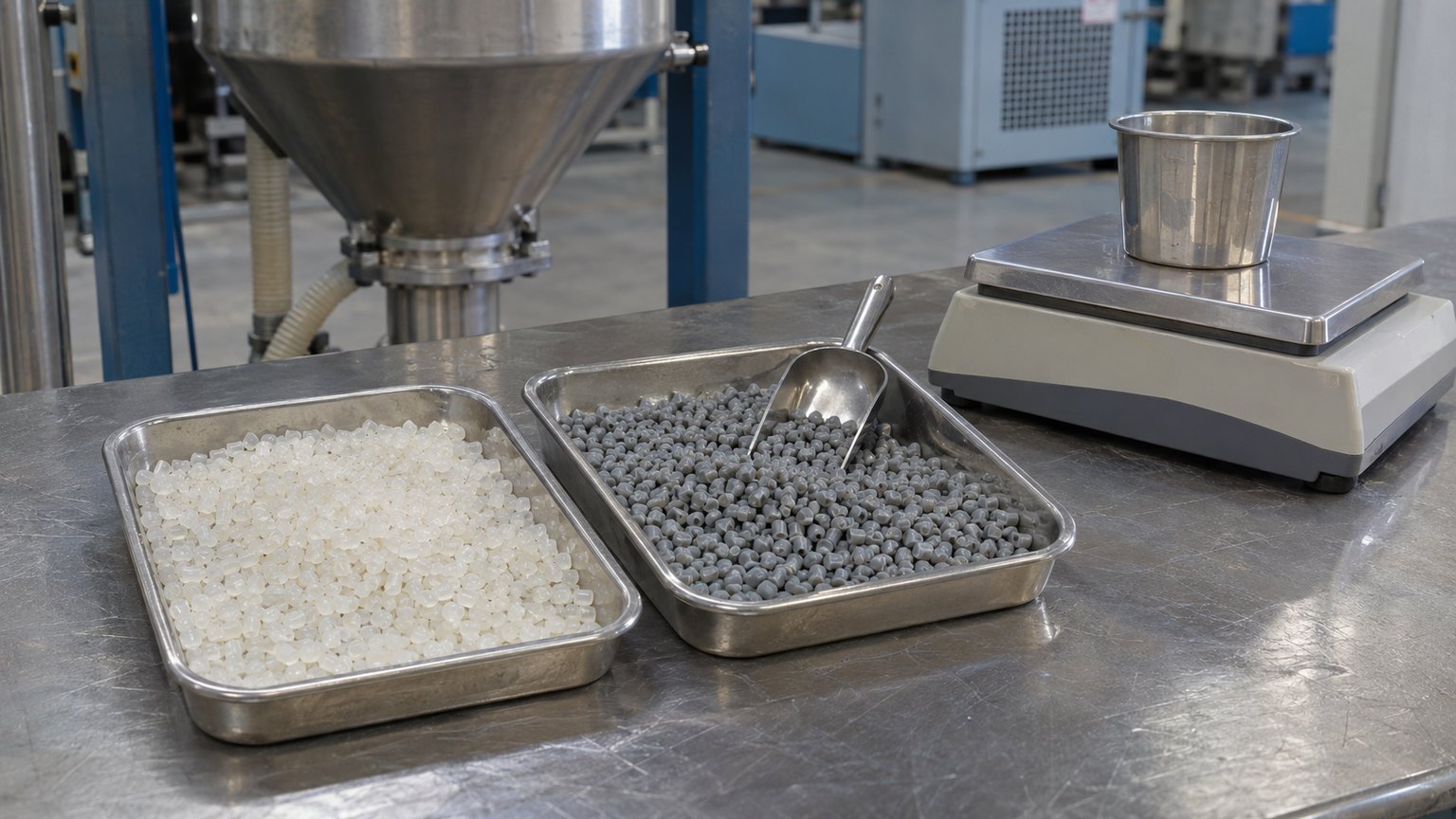
AI-generated educational reconstruction of pellet sampling and weighing. It does not depict a Nexis facility, an approved resin grade or a measured dosing trial.
A recycled PE trial can finish with the correct total material consumption while still leaving an unresolved question: did the intended blend reach the extruder consistently, including when the feeder hopper refilled? A shift total alone cannot show where a short dosing excursion occurred. Before blaming a new pellet batch for an intermittent film problem, check what the dosing system actually recorded.
This guide is for UK converters qualifying pelletised recycled PE for industrial blown or cast film, including shrink film and FFS bag film. It proposes a practical feeder trial and purchasing handover. It does not set a universal PCR percentage or feeder tolerance.
A current equipment development, with a practical buying implication
In its March 2026 newsletter, Coperion introduced an expanded feeding portfolio and a Feeder Finder covering applications including recycling and compounding. Different options address free-flowing pellets, difficult additives and light recycled materials. [1] The purchasing implication is to qualify the material–equipment combination at the required rate, rather than treating any machine described as gravimetric as interchangeable.
Start with the supplied pellet form. Coperion’s feeding guidance identifies particle geometry, bulk density and flow behaviour among the factors affecting equipment selection. [2] Give the equipment supplier representative material, including normal lot variation. A test on uniform virgin pellets does not establish performance with a different recycled stream.
Establish which dosing system you have
Volumetric dosing controls volume delivery; mass delivery also depends on bulk behaviour. A loss-in-weight feeder instead calculates delivery from the reduction in hopper weight and adjusts its drive towards the mass-rate setpoint. In the LIW arrangement described by Coperion, refill temporarily interrupts that weight-loss measurement: incoming material increases hopper weight, and the controller operates volumetrically during the refill interval. [3]
This is a reason to inspect refill performance, not evidence that a particular feeder is inaccurate. Ask the OEM how its controller handles refill and recovery, and which displayed values are measured, calculated or held estimates. A gravimetric batch blender has a different cycle; establish its weighing and discharge logic rather than applying a continuous LIW test unchanged.
For each extruder or layer, write down the feeder identities, ingredient routes and percentage basis. If an illustrative recipe contains 20 kg of recycled pellet stream, 80 kg of virgin resin and 2 kg of masterbatch, the stream represents 20/102, or about 19.61%, of total input mass—not 20%. This is arithmetic only, not a recommended formulation. It also says nothing about the independently documented PCR content of that supplied stream.
Agree the trial before changing the material
The following is a proposed engineering acceptance plan, not a published standard test method. The converter, material supplier and equipment specialist should agree the operating envelope, sampling resolution and decision limits before the trial.
- Identify the candidate and approved reference lots, pellet specification, recipe revision, feeder configuration and destination film application.
- Record the scale check and calibration status. Use the OEM-approved discharge-weighing or calibration procedure where an independent mass check is required; do not improvise sampling from a running production line.
- Define the required low, normal and high production rates. Check each ingredient’s actual required range, including the lowest planned recycled-material feed rate.
- Keep the initial comparison on the same line, recipe basis and operating conditions. Record unavoidable changes instead of describing the result as a material-only comparison.
- Specify how many refill events and repeat runs will be observed, the acceptable deviation and recovery criterion, and who may release affected rolls. Set these from the application and equipment capability; there is no universal value in this guide.
A supplier should receive the test brief with the sample request. A promising trial lot is useful only if its pellet form and agreed handling characteristics can be represented in repeat deliveries.
Preserve the refill event in the data
Request synchronised records of setpoint, reported delivery rate, hopper net weight, drive speed, refill status and alarms for the relevant feeders. Coperion describes net weight, feed rate and the drive-speed/feed-rate relationship as useful trend data. [3] Confirm what the controller exports during refill. A smooth calculated trace is not an independent measurement of uninterrupted mass accuracy.
Keep the raw time series alongside any averaged report. Choose a recording interval capable of resolving the actual refill and recovery sequence with the OEM; exporting only shift totals defeats that purpose. Separate stable running, refill, recovery and speed changes in the review.
As an additional reconciliation, compare documented material issued, material returned and inventory remaining over the defined trial boundary. Account for material retained in hoppers and transfer systems. This checks cumulative consumption; it cannot reconstruct a short excursion that was never measured. Retain both views rather than using one to dismiss the other.
Investigate the weighing environment before condemning the pellets
Coperion’s guidance on external influences identifies vibration, mechanical loading through connections and pressure changes as potential sources of weighing error. It also describes pressure disturbances associated with refill and blocked vent filters. [4] These are investigation leads, not a diagnosis from a trend alone.
Have the equipment specialist inspect the installation, flexible connections, venting and refill sequence. Record maintenance or conveying changes that coincide with the symptom. If the reference and candidate both show the same event, investigate the common equipment conditions. If only the candidate repeats the problem under matched conditions, examine its handling characteristics and feeder fit before increasing the purchase volume. Preserve the original data when adjustments are made.
Connect the feeder record to the finished roll
Time-stamp roll changes and samples, and establish the material’s travel delay through the particular line. Do not assume a refill timestamp corresponds immediately to film at the winder. For coextrusion, identify the affected ingredient route and layer as well as the total line output.
Compare film samples against the agreed product specification after stable running and across the relevant event window. Depending on the application, this may include thickness profile, visible defects, sealing or mechanical performance. Feeder acceptance and film acceptance are separate decisions: stable dosing does not prove a suitable resin formulation, and an acceptable average film result does not explain missing process records.
For the separate task of mapping thickness across a roll, see: https://www.nexisplast.com/en/insights/pe-film-thickness-variation-downgauging-uk
Make the commercial handover repeatable
State the approved material identity, pellet requirements, operating-rate envelope, refill acceptance criteria and records supplied with the trial. Agree which changes trigger review: source stream, pellet geometry, feeder parts, controller configuration or recipe. Define how suspect rolls are held and how a disputed delivery is resampled.
For a UK quotation, align currency, delivery point, order size and transport basis. Compare the cost of accepted film, including measured scrap, interruptions, checks and trial material, rather than assuming that a lower resin price produces a lower converting cost. No savings percentage follows from a feeder brochure.
Send Nexis the film application, existing resin and recipe, candidate recycled stream, extruder and feeder models, ingredient-rate range, refill trend, intended trial quantity, monthly tonnage and UK delivery postcode. Ask for available material specifications and a representative sample; availability and suitability are confirmed for the individual enquiry. Retain separate supplier evidence for recycled origin and content, because a dosing record establishes neither by itself.
Polymer raw materials: https://www.nexisplast.com/en/products/polymer-raw-materials
FFS bag film: https://www.nexisplast.com/en/products/ffs-bag
Technical enquiry and quotation: https://www.nexisplast.com/en/contact
Sources and review date
Published and sources checked on 8 November 2026. The operating principles below are manufacturer guidance; the acceptance plan and commercial interpretation above are Nexis editorial recommendations for adaptation to the actual installation. The 2020 references are identified as technical background, not presented as new developments.
[1] Coperion, Coperion’s new Feeder Finder, Plastics in Focus Edition 1/2026, March 2026: https://coperion.com/en/news-media/newsletter/2026/plastics-in-focus-edition-12026/feeder-finder
[2] Coperion, Feeding Technology, material characteristics and equipment selection; no publication date stated: https://www.coperion.com/en/know-how/technology/feeding-technology
[3] Coperion, How to Ensure Reliable Feeder Performance When Handling Recycled Plastics, December 2020; controller, refill and trend-data sections: https://www.coperion.com/en/news-media/newsletter/2020/plastics-infocus-edition-042020/reliable-feeder-performance
[4] Coperion, External Influences on Feeding Accuracy and How These Can Affect Overall Ingredient Costs, December 2020: https://www.coperion.com/en/news-media/newsletter/2020/plastics-infocus-edition-042020/external-influences-on-feeding-accuracy