
Labels on stretch wrap: protect your clear PE recycling stream
A UK distribution centre’s buying trial for clear pallet stretch film: compare label placement, scan performance and the collector’s accepted bale grade.
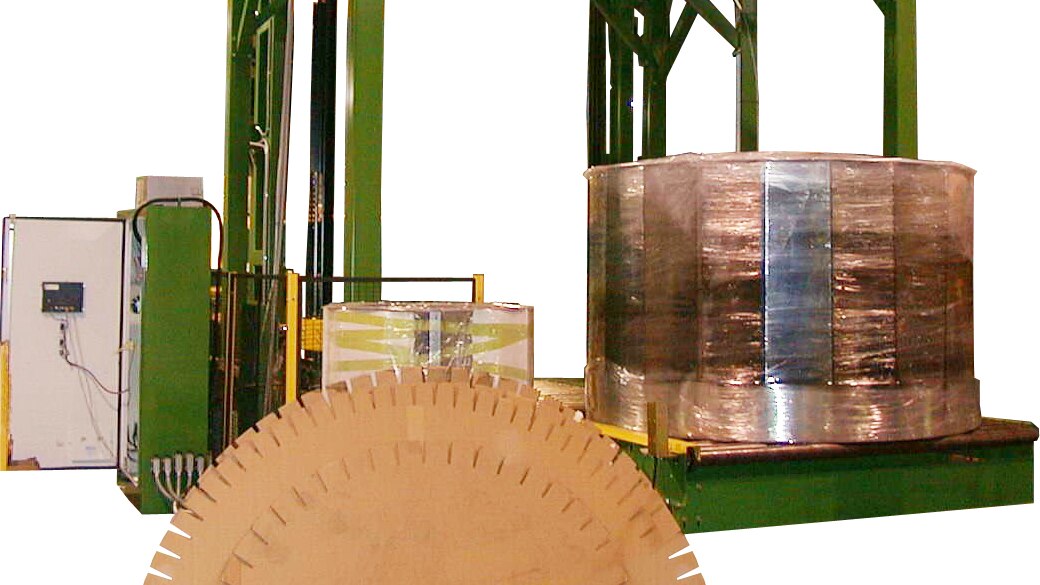
Photo: Imsquare22
Imsquare22 · Wikimedia Commons · Public domain · Archive photograph.
A UK distribution centre can buy clear PE stretch film and still hand its collector a mixed load. The film may leave the wrapper clean, then pick up paper barcode labels, tape or pieces of strapping before it reaches the baler. For warehouse and packaging buyers, the question is whether a change to the label or its position improves acceptance without making the pallet harder to scan or the load less secure.
Start with the collector’s specification
Ask the collector or reprocessor that takes the site’s film to confirm its clear-film grade in writing. Request separate rules for attached labels, loose paper, tape, coloured film, strapping, moisture and bale ties. Ask how the collector samples a load and whether a miss means a lower grade, a sorting charge or rejection. For example, UK buyer Cyclomer lists a 95/5 grade and a separate 98/2 premium grade, with different acceptance conditions. Those are one buyer’s grades; a threshold from its website does not tell you what your own collector will take. [1]
Check the legal and commercial files separately. PackUK’s published 2027 overview says that in-scope large producers use RAM v1.1 for the 2026 reporting year when assessing household packaging. This article concerns a warehouse’s separate, commercial stretch-wrap stream; it does not assign a RAM rating or determine a producer’s reporting duties. Confirm classification with the responsible team if the same packaging reaches households. [2]
Compare label position before changing the film
Start by following a pallet from wrapping and despatch to goods-in, put-away, unwrapping and the film bin. Identify which label must remain visible, what scanners read it and whether another part of the load can carry it. Compare the incumbent label on the outer film with the same label on a carton face or a removable holder, wherever the customer and scan process allow. A label on a carton behind several layers of stretched film may be hard to scan because of reflection, overlap or a fold. If warehouse staff need to remove a label or holder before baling, make that a defined task at the point of unwrapping.
Where the label has to stay on the wrap, obtain the facestock polymer or paper type, adhesive chemistry or supplier identifier, adhesive coat weight where available, and label size and count per pallet. Ask for test evidence for the label and adhesive as a pair on the intended film. RecyClass’s natural PE film guidelines, updated in March 2026, treat PE and paper facestocks differently and consider the adhesive separately. Its lab washing procedure tests a label-and-adhesive combination under specified conditions; passing that screen does not prove that the material will be accepted by the contracted UK outlet. [3, 4]
Run a two-part acceptance trial
- On the wrapping line, start with the same pallet and load geometry, wrap pattern, film and machine settings. Change label location or label construction one at a time. Check first-pass scans at despatch and goods-in, readability after normal handling, and that the baseline load stability is maintained. Include the awkward pallet faces your operators actually use.
- At the waste station, keep trial and control film separate over comparable shifts. In representative samples, record total sample mass and separately weigh removable labels, tape and other contaminants using the collector’s definitions. Record bonded material that cannot be removed; agree how the collector will count it. Log moisture and the film mix separately so wet loads or coloured film do not mask the effect of the labels.
- Give the collector a sample or trial bale before scaling. Ask for the received grade, rejected materials, pricing basis and any handling instructions in writing. Set scan and waste acceptance limits before comparing results. A configuration that improves the bale but causes missed scans or insecure loads should be revised before it is approved.
Put the real cost into the buying decision
Compare the two configurations per 1,000 despatched pallets: film and label spend, time spent relabelling or peeling, segregation and transport charges, and the value or charge for the grade the collector actually accepts. Compare on the same delivered basis and include any added labour at goods-in. In the purchase order, record the accepted film description, label construction, placement drawing, collector’s rule and who signs off a substitution. If the adhesive or label stock changes, recheck both scan performance and the waste outlet before accepting the change.
For a Nexis technical sheet, trial roll or quotation, send the wrapping machine, pallet dimensions and load, current film width and gauge, label format and location, monthly usage and delivery postcode. If clear-film recovery is part of the brief, add the collector’s acceptance rule.
Nexis industrial stretch film: https://www.nexisplast.com/en/products/stretch-film
Request technical information or a quotation: https://www.nexisplast.com/en/contact
Sources
[1] Cyclomer, UK clear LLDPE stretch film buying specifications; accessed 18 November 2026: https://cyclomer.co.uk/we-buy/lldpe-stretch-film
[2] PackUK and Defra, RAM 2027 overview and instructions on the 2026 reporting year; accessed 18 November 2026: https://www.gov.uk/government/publications/assess-packaging-recyclability-recyclability-assessment-methodology-ram-2027/ram-2027-overview
[3] RecyClass, Design for Recycling Guidelines for Natural PE Flexible Packaging; March 2026 update: https://recyclass.eu/wp-content/uploads/2026/04/RecyClass-DfR-Guidelines-Natural-PE-Films.pdf
[4] RecyClass, Washing Quick Test for film labels on PE and PP flexibles, version 1.0; accessed 18 November 2026: https://recyclass.eu/wp-content/uploads/2025/10/RecyClass-Washing-QT-Procedure-for-Film-Labels-applied-on-PE-and-PP-Films-v1.0.pdf