
Recycled PE shrink film: evidence UK buyers should request
A UK buyer’s checklist for recycled PE shrink film: connect supplier evidence to each delivery, distinguish 2026 rules from 2027 plans and check pack performance.
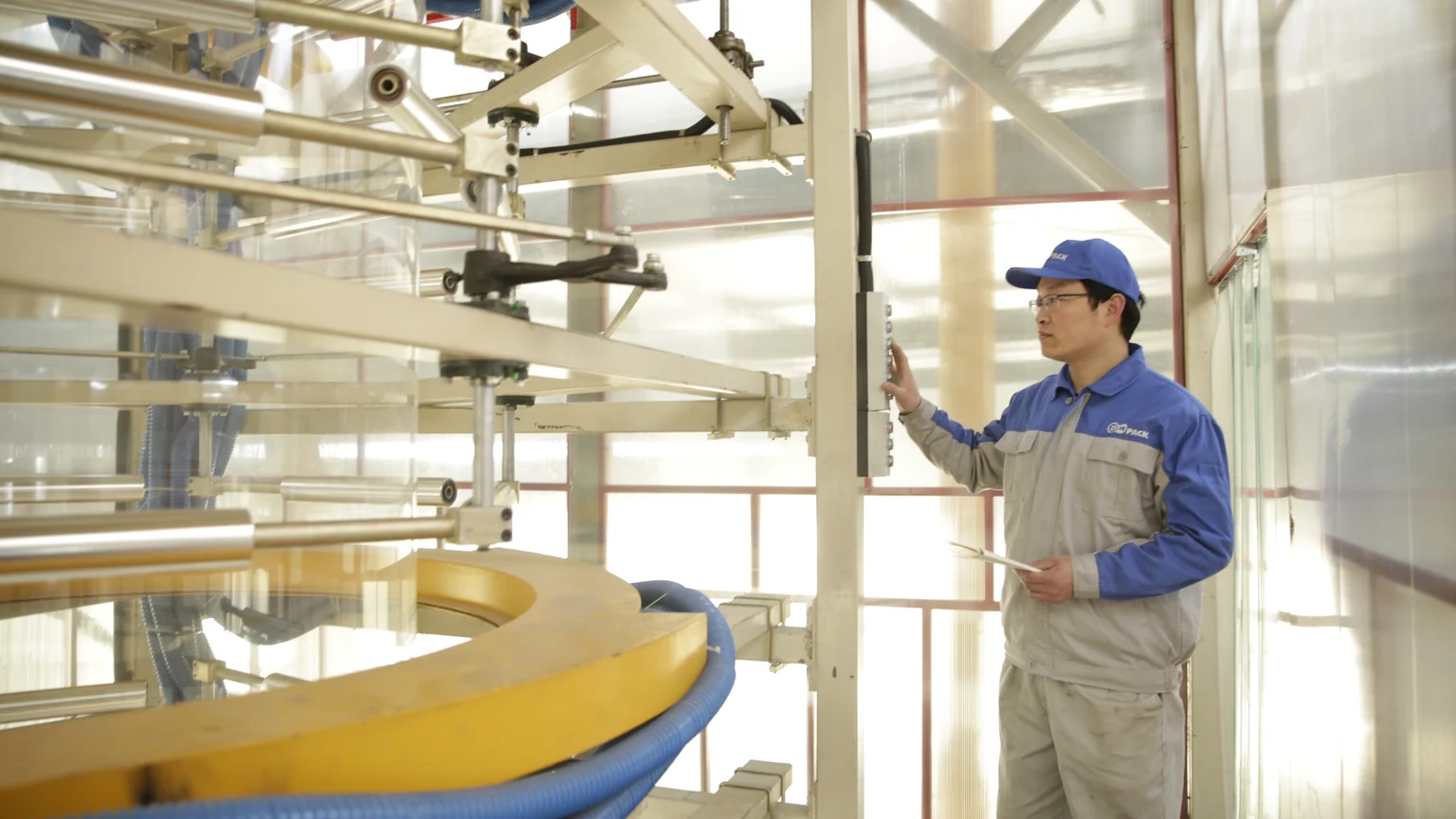
Illustrative photograph of polyolefin shrink-film production, as described by its source. It is not a Nexis facility and does not verify the polymer formulation or recycled content of any supplied film.
DMPACK · Wikimedia Commons · CC BY-SA 4.0 · Cropped to 16:9, resized and converted to WebP. This image adaptation is also available under CC BY-SA 4.0.
Buying recycled PE shrink film for the UK involves two different approvals: whether the recycled-content claim is supported, and whether the film protects the actual bundle at the required packing speed. A supplier statement saying “30% recycled” does not, by itself, answer either question for a particular delivery.
This guide is for buyers and converters assessing secondary, non-food-contact shrink packaging. It proposes a commercial handover between purchasing, quality and the business responsible for Plastic Packaging Tax (PPT). It is not a tax determination, a declaration of compliance for Nexis products or an instruction to use a particular recycled percentage. Confirm the treatment of your own packaging with current HMRC guidance and your tax adviser.
Why the distinction matters in October 2026
HMRC’s 28 August 2026 guidance prepares businesses for chemically recycled attribution from 1 April 2027. A draft-regulations consultation followed on 6 October. These documents matter for future contracts; they do not establish a mass balance regime already operating in October 2026. [1, 2]
The preparation guidance distinguishes chemically recycled attribution from mechanically recycled plastic: businesses accounting only for mechanically recycled material cannot use that mass balance approach. Therefore, ask which recycling route a supplier’s claim concerns before discussing certificates. A future attribution arrangement is not a substitute for the evidence needed for a current mechanically recycled film supply. [1]
Define the claim before asking for a certificate
Write down whether the requirement is for physically incorporated post-consumer recycled PE, another qualifying recycled stream, or chemically recycled attribution under a specified future arrangement. Do not treat these descriptions as interchangeable. Also separate recycled content from recyclability: one describes the material input or attribution claim, while the other concerns what can happen after use.
For current PPT record keeping, HMRC says the 30% condition is measured against the total weight of plastic in the packaging component. Supporting records must identify the calculation, relevant component or production run, source and dates. A figure for one input resin is not automatically the figure for the finished film. The responsible business should establish the component and calculation basis before accepting an offer. [3]
Keep the purchasing requirement equally clear. If a customer specifically asks for post-consumer material, a broader “recycled” description may not meet that contract even before tax treatment is considered. Ask the supplier to resolve ambiguous wording in writing rather than silently interpreting it.
Connect the evidence to the consignment
HMRC’s records guidance allows evidence from the packaging manufacturer or a robust supply-chain audit for imported packaging with at least 30% recycled plastic. It also requires separate evidence when the specification or materials change. A general corporate sustainability report is therefore not a practical replacement for identifying what was supplied. [3]
The following is a suggested Nexis procurement checklist, not an official mandatory form. Use it to build a file that purchasing and the responsible compliance team can both follow:
- Identify the converting site, product specification revision, film format and production period.
- Link the manufacturer’s recycled-content statement to the relevant product line or production run, then link the supplied rolls to the delivery and invoice.
- Ask who made the calculation and what supporting records or audit route can substantiate it.
- Reconcile roll and delivery quantities against the agreed specification; flag discrepancies before release.
- Record the reviewer, review date and any outstanding clarification, rather than marking an incomplete file “approved”.
Keep audit references and their scope visible. A certificate for a different site, date or activity should prompt a question; it should not be used to fill a gap in an unrelated claim. HMRC’s due-diligence guidance recommends proportionate checks, including cross-checking specifications and supplier information, and recording who makes those checks and when. [4]
Treat 2027 attribution as a separate procurement workstream
For future chemically attributed supply, separately review certification, attribution declarations and the relevant supply-chain evidence. HMRC’s August guidance says more detail will follow in early 2027. [1]
Do not promise that a generic certification logo automatically establishes future PPT eligibility. In the contract, identify the claimed route and who will provide the evidence required at the time of supply. Review the final rules and guidance before relying on a 2027 delivery arrangement; the October consultation is explicitly a draft. [2]
Run a physical film approval alongside the document review
Evidence of recycled content does not establish shrink behaviour, seal integrity or pack robustness. Conversely, a successful tunnel trial does not prove the origin or proportion of recycled material. Keep both review results attached to the same approved specification.
ExxonMobil’s collation-shrink materials describe combining recycled PE with performance PE and adjusting formulations for different applications. This is evidence that specific engineered structures can work, not a guarantee for any recycled feedstock, film thickness or Nexis supply. [5]
Start the technical brief with bundle dimensions and mass, unit arrangement, current film structure and thickness, reel constraints, sealing method, tunnel and target line speed. Name the existing defects and the handling conditions the bundle must survive. Do not change the recycled feedstock, thickness and tunnel settings simultaneously if the trial is intended to explain the effect of a material substitution.
Use a repeatable trial, not an attractive sample pack
Agree the acceptance criteria with the pack owner before running the candidate film. Use a reference film already accepted for that bundle, and retain samples from identified rolls. The proposed comparison should include:
- Film thickness distribution and a documented laboratory shrinkage comparison under defined conditions.
- Seal continuity, holes, wrinkles, bundle fit and appearance after the agreed packing cycle.
- Breaks, rejected bundles, start-up waste and sustained operation at the target speed.
- Bundle behaviour after the agreed cooling, storage and representative handling sequence.
ASTM D2732-14(2025) covers unrestrained linear thermal shrinkage. Use the complete applicable method and record the conditions when commissioning this test. Free-shrink results do not measure every aspect of restraint around a filled bundle; do not substitute one laboratory percentage for a packing-line and handling assessment. No universal temperature, dwell time or pass limit is prescribed here. [6]
When a trial fails, describe the failure and its location. Preserve photographs and roll identification, and distinguish a process adjustment from a formulation change. Repeat approval after material changes according to the change-control plan agreed with the supplier.
Compare cost per accepted bundle on a common basis
Put suppliers on the same delivery basis and specification. Compare delivered film cost, consumption and measured waste for an agreed number of accepted bundles. Include relevant trial or verification costs consistently, rather than assuming that a lower price per kilogram means a lower packing cost.
Keep any assumed PPT treatment outside the material-performance calculation until the responsible business has confirmed it. This prevents a provisional document claim from turning into an unsupported saving in a purchase recommendation. No polymer price, tax-saving forecast or claimed recycled percentage for a Nexis product is supplied in this article.
Send Nexis an RFQ with two approval gates
Send the bundle drawing or photographs, current film specification, line and tunnel details, trial quantity, expected monthly volume and UK delivery postcode. Add the exact recycled-content claim required by your customer and the supporting documentation your compliance reviewer needs.
Ask for separate confirmation of a technically suitable sample and the availability of evidence for the proposed supply. Nexis can review shrink-film and polymer-material options against that brief. Availability, formulation, documentation and final acceptance must be confirmed for the particular product and order; neither an illustration nor this guide is a product certificate.
Shrink-film application and sample enquiry: https://www.nexisplast.com/en/products/shrink-film
Polymer raw materials for formulation discussions: https://www.nexisplast.com/en/products/polymer-raw-materials
Share the technical brief and UK delivery requirements: https://www.nexisplast.com/en/contact
Primary sources and review date
Reviewed on 16 October 2026. The proposed RFQ checklist, trial sequence and purchasing handover are Nexis editorial recommendations. Check the latest official guidance and the final terms of the specific supply before making a tax or compliance decision.
[1] HMRC, Preparing to use a mass balance approach for Plastic Packaging Tax, published 28 August 2026; preparation for 1 April 2027, not a statement of an already-operating 2026 regime: https://www.gov.uk/guidance/preparing-to-use-a-mass-balance-approach-for-plastic-packaging-tax
[2] HMRC, Draft legislation: chemical recycling and adoption of a mass balance approach, published 6 October 2026; technical consultation on draft provisions: https://www.gov.uk/government/consultations/draft-legislation-plastic-packaging-tax-chemical-recycling-and-adoption-of-a-mass-balance-approach
[3] HMRC, Records and accounts you must keep for Plastic Packaging Tax, updated 2 February 2023; current page reviewed 16 October 2026: https://www.gov.uk/guidance/record-keeping-and-accounts-for-plastic-packaging-tax
[4] HMRC, How to make due diligence checks for Plastic Packaging Tax, updated 15 September 2023: https://www.gov.uk/guidance/how-to-make-due-diligence-checks-for-plastic-packaging-tax
[5] ExxonMobil Product Solutions, Collation shrink packaging; undated manufacturer page, reviewed 16 October 2026. Application claims are specific to the manufacturer’s solutions: https://www.exxonmobilchemical.com/en/industries/packaging/collation-shrink-packaging
[6] ASTM D2732-14(2025), Unrestrained Linear Thermal Shrinkage of Plastic Film and Sheeting, active edition; page updated 12 December 2025: https://store.astm.org/d2732-14r25.html